


Agentic AI: How Businesses Automate Complex Operations

24 August 2026

Share this article

Agentic AI refers to autonomous systems capable of planning, using tools, and making decisions to achieve complex goals with minimal human intervention. Unlike traditional AI that simply generates content, agentic AI acts as a digital worker, managing end-to-end workflows to optimize business operations and drive efficiency.

What Is Agentic AI and How Does It Differ from Traditional AI?

To understand the shift toward agentic systems, we must first distinguish them from the Generative AI (GenAI) models that dominated recent headlines. While standard Large Language Models (LLMs) are excellent at predicting the next word in a sentence or summarizing a document, they are essentially passive. They wait for a prompt, provide a response, and stop.

Agentic AI, however, represents a paradigm shift from "AI as a chatbot" to "AI as an agent." These systems possess a level of agency—the ability to perceive their environment, reason through multi-step problems, and take actions using external tools. Instead of just writing an email, an agentic system can identify a customer’s problem, access a CRM to check their history, look up shipping status in a logistics database, and then initiate a refund or schedule a call without a human having to guide every single click.

At Peach Loves , we see this as the natural evolution of digital transformation. Traditional software forces your business to adapt to its rigid structure. In contrast, Agentic AI adapts to your business logic, acting as an intelligent layer that sits across your existing ecosystem to bridge gaps between siloed applications. The difference lies in three core capabilities:

  • Autonomy: The ability to operate without constant human prompting.
  • Reasoning: Using logic to break down a high-level goal into smaller tasks.
  • Tool-Use: The capacity to interact with APIs, databases, and web browsers.
Rows of black server racks in a modern data center with glowing blue network lines connecting them

Key Components of an Agentic AI System

Building an effective agentic system requires more than just a powerful model; it requires a structured architecture that mimics human cognitive functions. Forward-thinking organisations are moving away from simple wrappers and toward robust frameworks that include several critical components.

First is the Planning Module . This is where the AI takes a complex request—such as "Optimise our inventory for the next quarter based on current sales trends"—and decomposes it. It creates a roadmap, identifying which data points it needs and which departments are involved. This "Chain of Thought" reasoning allows the agent to handle ambiguity that would crash a traditional automated script.

Second is Memory . For an agent to be useful, it needs to remember previous interactions and context. There are two types: short-term memory, which keeps track of the current task’s progress, and long-term memory, often powered by vector databases, which stores historical data, company policies, and past successful strategies. This ensures the AI learns from your business's specific nuances over time.

Third is Action/Tool Execution . This is the "hands" of the AI. Through secure API integrations, the agent can query databases, execute code, or interact with third-party software like Slack, Jira, or Salesforce. By building technology around your business rather than forcing you into a pre-set box, these agents become bespoke digital employees tailored to your unique operational flow.

How Are Forward-Thinking Businesses Using Agentic AI Today?

The transition to autonomous operations is already happening across various sectors in South Africa and globally. Companies are no longer satisfied with simple automation; they are looking for systems that can handle the complexity of the real world.

In Supply Chain and Logistics , businesses are deploying agentic AI to manage disruptions. When a shipment is delayed, an autonomous agent can automatically assess the impact on downstream production, search for alternative suppliers, calculate the cost-benefit of expedited shipping, and present a fully-formed solution to the operations manager for final approval. This reduces response times from days to minutes.

In Customer Success and Support , the leap is even more dramatic. We are moving past the "I don't understand your question" era of chatbots. Agentic AI can troubleshoot technical issues by actually interacting with the user's account logs, performing diagnostic tests in the background, and even guiding the user through a complex setup process in real-time. This level of service was previously only possible with high-touch, expensive human intervention.

Software Development and IT Operations are also seeing massive gains. Agents can now assist in "Self-Healing" infrastructure. If a server experiences a spike in latency, an agentic system can investigate the logs, identify the rogue process, deploy a patch or scale the resources, and then document the entire incident in the company's internal wiki. This allows IT teams to focus on innovation rather than fire-fighting.

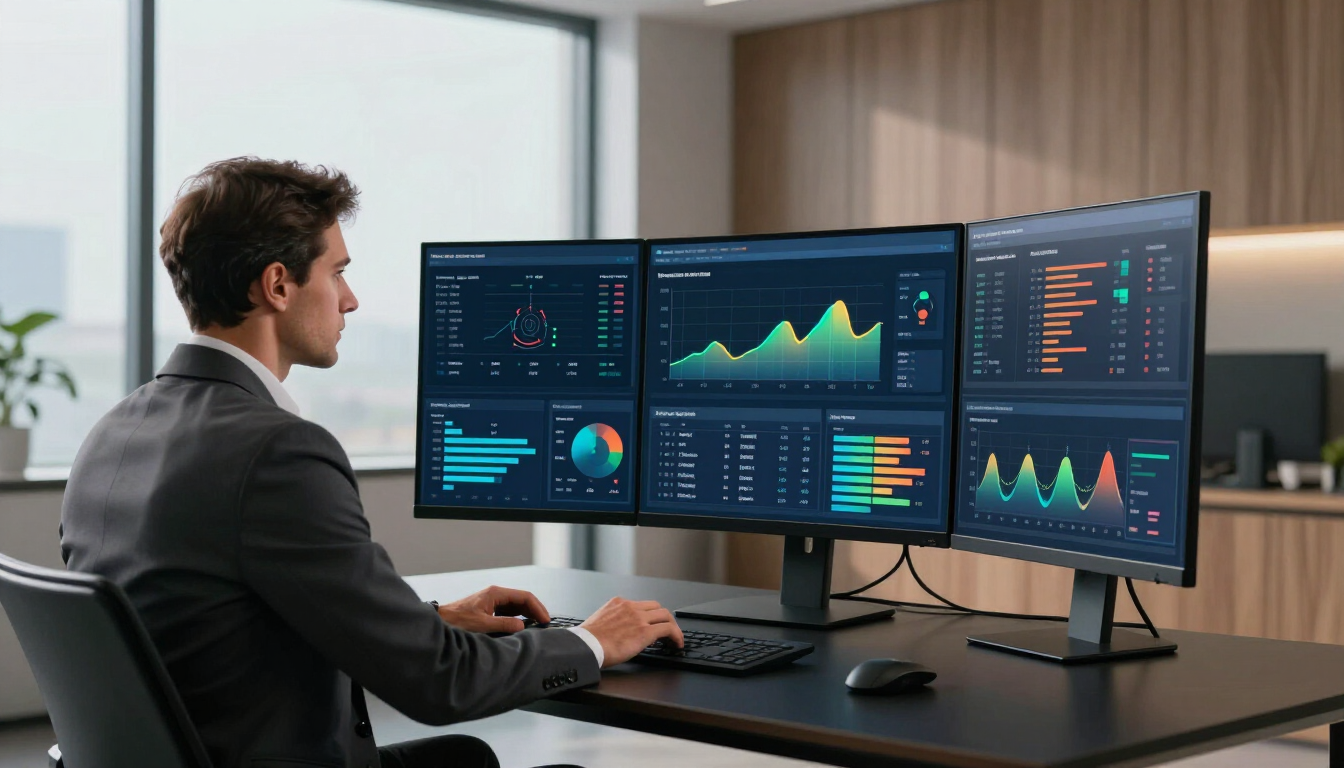
Person working at a desk with three monitors showing colorful business analytics dashboards

Benefits of Implementing Agentic AI in Operations

The primary driver for adopting agentic systems is the ability to scale intelligence. While traditional automation scales repetition , agentic AI scales decision-making . This distinction is vital for organisations looking to grow without a linear increase in headcount and overhead costs.

  1. Increased Operational Speed: Agents work at machine speed, processing thousands of variables simultaneously to find the optimal path forward.
  2. Reduction in Human Error: By automating data entry and cross-referencing across multiple systems, agents eliminate the fatigue-related mistakes common in manual workflows.
  3. Enhanced Employee Satisfaction: When AI handles the mundane, multi-step administrative tasks, your human talent is freed to engage in high-value creative and strategic work.
  4. Continuous Improvement: Agentic systems can be designed to analyze their own performance, suggesting improvements to the workflows they manage.
  5. 24/7 Availability: Unlike human teams, autonomous agents can monitor and manage operations around the clock, ensuring that global businesses never miss a beat.

For businesses interested in these advancements, exploring how to become a partner in our ecosystem can provide the specialized engineering expertise required to build these bespoke systems from the ground up.

What Challenges Should You Anticipate When Deploying Autonomous Agents?

Despite the immense potential, the road to fully autonomous operations is not without its hurdles. Because agentic AI has the power to take actions, the risks associated with error or misalignment are higher than with standard generative models. The first major challenge is Governance and Control . Businesses must implement "human-in-the-loop" checkpoints where the AI can act autonomously up to a certain threshold of risk, but must seek authorization for high-stakes decisions.

Another significant concern is Data Security and Privacy . As these agents require deep access to internal systems to be effective, ensuring that they operate within a secure, sandboxed environment is paramount. You cannot simply plug a generic public AI into your core business data without robust security protocols. This is why bespoke technology, engineered specifically for your infrastructure, is the only viable path for most enterprise-level organisations.

Finally, there is the challenge of Integration Complexity . Most legacy systems were not designed to be navigated by AI agents. Retrofitting these systems with the necessary APIs and data pipelines requires a deep understanding of both the business process and the underlying software architecture. It is not just a matter of installing an app; it is about re-engineering the digital fabric of the company.

Future Trends in Business Automation

Looking toward late 2026 and beyond, we anticipate the rise of Multi-Agent Orchestration . Instead of one giant AI trying to do everything, businesses will deploy a "fleet" of specialized agents. One agent might handle procurement, another logistics, and a third finance. These agents will communicate with each other, negotiating terms and coordinating schedules to achieve the overarching goals of the company.

We also expect to see the democratization of agent creation. With low-code and no-code tools becoming more sophisticated, department heads—not just IT teams—will be able to "hire" and train digital agents to handle specific departmental bottlenecks. However, the need for a centralized, professionally engineered core will remain to ensure all these agents play nicely within the corporate ecosystem .

As we build technology around your business, the goal is to create a seamless interface between human intuition and machine efficiency. The future of work is not humans vs. AI, but humans as the directors of a highly capable, autonomous digital workforce.

Summary: Implementing Agentic AI for Long-Term Success

Agentic AI represents the shift from passive tools to active digital partners. By empowering AI to plan, reason, and use tools autonomously, forward-thinking businesses are unlocking new levels of efficiency and scalability that were previously impossible. Whether it is managing complex supply chains or providing high-touch customer support, the applications are limited only by the quality of the engineering behind them.

  • Define clear goals: Start with a specific, high-friction operational process.
  • Prioritize security: Ensure your agentic architecture is built on a private, bespoke foundation.
  • Iterate slowly: Use human-in-the-loop systems to build trust in the AI's decision-making.
  • Focus on integration: The value of an agent is tied to its ability to talk to your existing tools.

Ready to transform your operations with custom-built Agentic AI? Contact the team at Peach Loves today to discuss how we can engineer a bespoke digital system that matches your ambitions perfectly.

Recent Posts

Modern office desk with monitor displaying a blue CAD floor plan, keyboard, and mouse
24 August 2026
Learn why bespoke digital architecture beats software sprawl. Discover how custom software and AI transform operations for South African businesses through strategic engineering.
Abstract glowing AI brain connected to a laptop screen with digital data streams on a dark background
24 August 2026
Learn the difference between AI Engineering vs AI Integration. Discover which strategy fits your business goals, budget, and digital transformation timeline.

Modern control room with rows of computer monitors displaying blue data dashboards
24 August 2026
Learn how a major telecoms provider achieved rapid growth and operational efficiency using bespoke software solutions designed for sales scaling and automation.

Four coworkers in a modern office meeting around a table with laptops and a whiteboard.
24 August 2026
Explore the behind-the-scenes journey of bespoke digital system delivery at Peach Loves. Learn how we engineer custom software and AI that transforms operations.

Person working at a desk with dual monitors showing diagrams in a bright office
24 August 2026
Discover why UX design is more than just visuals. Learn how bespoke user experience design transforms customer loyalty and operational efficiency for South African businesses.

Blue and silver network hub icon with radiating lines on a light background
24 August 2026
Discover why a digital growth partner is essential for scaling through custom software, AI, and bespoke technology tailored to your business.
Interlocking silver gears over a glowing blue circuit board, symbolizing technology and automation
24 August 2026
Learn the true costs of software silos and how professional system integration saves time, reduces errors, and boosts ROI for modern businesses.

Modern office desk with three blue data screens, keyboard, mouse, and black chair
24 August 2026
Discover why off-the-shelf CRMs often hinder growth and how a custom CRM system tailored to your business operations can drive efficiency and scalability.
Modern office with people viewing a large wall display of blue analytics charts
24 August 2026
Compare off-the-shelf vs. bespoke software to find the best fit for your business. Learn when to switch to custom solutions for better ROI and scale in 2026.